10 Reasons Why You Should Be Using Microfiber to Clean

| By Mandy Peterson

Microfiber cloths:

  • are non-abrasive: Looped microfiber is ideal for gently "buffing" dirt off from delicate surfaces such as glass or screens.
  • are lint-free (in most cases).
  • give a streak-free clean. The average "normal" cleaning rag pushes dust and dirt around, causing smearing.
  • do not scratch surfaces.
  • grab dust/grime particles.
  • soak away liquid (even oil) with fantastic wicking action.
  • become electrostatically charged, which also helps attract/remove dust, hair, and little "fuzzies."
  • dry quickly because of their special loop weave. In fact, this material dries in one-third the time of ordinary cleaning cloths.
  • are absorbent. Microfiber holds up to seven times its weight in liquid. With a couple of firm wrings, this impressive material is ready to mop up until the mess is gone.
  • are washable and reusable (washable up to 500 times).

Flat weave versus looped weave:

Microfiber is a blend of two synthetic material types: polyesters and polyamides, and there are two different ways that microfiber is woven together. One is the "flat" weave and the other is a "looped" weave.

Flat weave: This weave repels water and is used in the textile industry for making water-resistant clothing and accessories such as watchbands. This type of microfiber – and any other type of fabric which is similarly woven –  is not ideal for use as a cleaning cloth since it will only push particles around and not absorb them.

A super-magnified view of flat-woven microfiber.

Looped weave: To be useful for cleaning, microfiber must be separated during processing. This method consists of splitting the polyester (the scrubbing fiber) from the polyamide (the absorbing and quick-drying fiber). Once the microfiber is split, the fibers are woven into a fabric. The percentage of material normally consists of 70% to 80% polyester and 20% to 30% polyamide, depending on the style of fabric construction.

The polyester and polyamide are then combined during weaving to create hundreds of thousands of microscopic "loops." This web-like formation of "loops" grabs dust, grime, dirt, and oil and traps it within the weave, making this material one of the safest cleaning tools to use.  

A super-magnified view of looped weave microfiber.

What makes loop-weaved microfiber so superior for cleaning?

Microfiber cloths are green and eco-friendly because they can be re-washed with a mild detergent in the washing machine and can even be placed into the dryer. Fabric softener should never be used with microfiber cloths because it weakens the static charge of the filaments and reduces the effectiveness.

Also available on the Photodon website:

Sample Cloth Packs for trying a few microfiber cloths without a large commitment.

Silky Microsoft Cleaning Kit

Promotional Microfiber Cloths

Photodon offers many different weaves of microfiber cloths. From cloths to clean lenses and smaller screens to cloths for cleaning larger screens like computer monitors and TVs, there is a microfiber cloth for every purpose. There are also general-purpose cloths that work great on other surfaces.

You can contact us at 847-377-1185, M-F 9:00a.m – 5:00pm EST, or email us at [email protected] for more information.

Traverse City, MI, Small Biz Makes Face Shields To Help Save Lives

| By Jolynn Paige

When owner Don Basch listened to Michigan's Governor Gretchen Whitmer address citizens on March 23, 2020, he, along with everyone else in the state, heard the news that all non-essential businesses were ordered to close their doors until at least April 13th.  That night, Don went home, got on the internet, and researched what he could do to help protect the medical and emergency responder professionals in his Traverse City community. 

Don Basch, owner of Photodon, pictured wearing a personal protection mask he made.
Don Basch, owner.

“I found a local group that shared Google doc showing PPE items that hospitals are needing to help keep doctors and nurses protected.  One of the items was face shields with a suggested design.”  Don went to the Photodon shop and got to work making a shield using some materials he had in stock. After tinkering with the shield pattern, he constructed the first shield.  He also ordered some additional supplies needed to make the shields.   

Photodon shop worker assembling personal protective gear to help medical workers during the coronavirus epidemic.
Angela W. assembling personal protective face shields to help medical and other emergency personnel during the coronavirus pandemic.

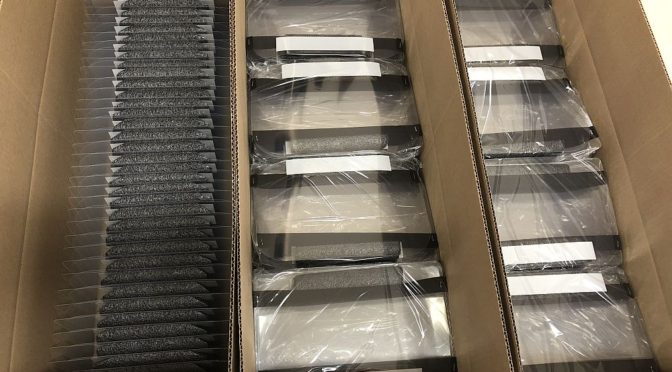
“We now have supplies on hand to make about 1,500 shields,” Don said.  Photodon plans to provide as many shields as they can and currently have face shields ready to deliver.  “We just want to do what we can to help with what we are capable of doing,” Don said.   

Interested organizations should contact Photodon by emailing [email protected] or calling us at 847-377-1185, M-F 9:00a.m – 5:00pm EST.  

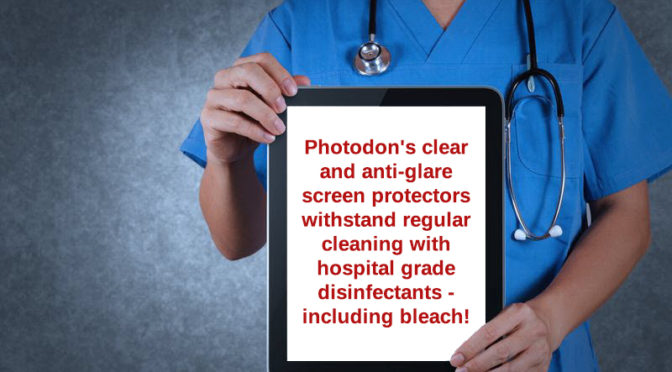
Photodon's screen protectors can be cleaned with disinfectants and bleach.

Clean Photodon Screen Protectors with Bleach and Sanitizers

| By Jolynn Paige

What Hospitals Need to Know About Our Products  

Now that the coronavirus has arrived, electronic devices are being cleaned regularly, especially ones used in medical facilities.  To ensure these devices are cleaned properly, hospital-grade type disinfectants are being used directly on expensive digital screens which, if not protected, can cause damage to the screen.  Our screen protectors hold up to harsh chemicals and can save your device screen’s life.  Below you’ll see what we did to prove this.  

  
The Test – HSC and MXH Screen Protectors and Anti-Bacterial Cleaning Solutions: 

Our Photodon lab technicians created a bleach test to see how our HSC and MXH screen protector materials would hold up to being regularly cleaned with hospital-grade Clorox Bleach Germicidal Wipes. 

We used a standard office monitor and wiped down the screens two times daily with the bleach wipes for a period of 30 days.  The results were clear:  the screen protectors' clarity and protection were not compromised, which means the screen itself was not either! 


Features and Specifications of Photodon’s HSC and MXH Screen Protectors: 

Our screen protectors can be part of your company’s cost-reduction program by avoiding the need to replace expensive screens, whether it be for medical equipment screens that can be damaged by regular and necessary cleaning requirements especially at this time, to manufacturing-type devices, laptops, monitors, TVs, or any other device screen. 

Our HSC and MXH Materials: 

  • Are resistant to yellowing, even when cleaned with harsh chemicals 
  • Are touchscreen-compatible 
  • Are an affordable solution 
  • Are great protection for your screen and offer different finishes.  HSC is a clear, glass-like option, where MXH offers an anti-glare, matte finish 
  • Protect your devices from scratches and blunt force impact 
  • Withstand daily wipe-downs with hospital-grade disinfectants, including bleach wipes 
  • Can be custom-cut for any device (up to 40.5” tall) 
  • Are easily removable with no residue left on the screen 
  • Come with installation kits and detailed instructions for an easier installation 

Photodon’s Advice: 

Replace the screen protector – not the screen. 

While we have not tested our other materials, we believe that our other screen protector material types would respond the same way if tested with the bleach wipes. Should chemicals degrade the PET material over time, it can be inexpensively replaced, while the same cannot be said of replacing the actual device screen. 

The Bottom Line: 

Touchscreen use is increasing in medical-type environments from patients using equipment to check in and check out, to doctors, nurses, lab technicians, and other staff.  It pleases us to know that we can provide a high-quality, affordable option for protecting these heavily used and expensive devices. We specialize in custom solutions, and we offer 11 screen protector materials and 3 privacy filter materials. We have quick turn-around times and will work with you to get you what you need when you need it! 

You can contact us at 847-377-1185, M-F 9:00a.m – 5:00pm EST, or email us at [email protected].

More Information

Photodon's Growth Leads to a Big Move

| By Jolynn Paige

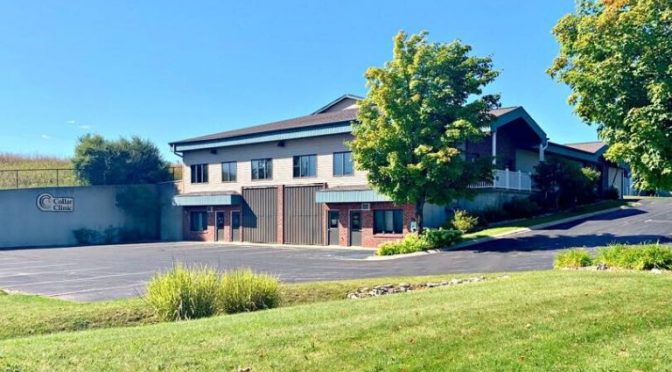
What better way for a business to start out a new decade than to move into a big, beautiful building?  After 20 years of expanding and 8 years of renting, Photodon's owners, Don and Jeanette Basch, decided it was time to invest in their own building. "We've known for quite a while that the business was growing out of our rented space. We just needed to find the right fit," said Don. Continue reading

Picture of many colors of microfiber cloths

Fascinating Features of Microfiber Cloths

| By Mandy Peterson

What is a Microfiber Cloth?

The word "microfiber," as you can imagine, means small fiber.  How small you ask?  I could go on and on using words such as denier, decitex, and micrometers, but who really knows THOSE words?  So instead of making you go to the web (unless you're smarter than me), I’ll put it in layman’s terms:  Most microfibers are about 1/5 of the diameter of a human hair.  These synthetic microfibers are most commonly made from polyester and polyamide.

Continue reading

Picture of Motion R12 12.5" Rugged Tablet with privacy filter

Privacy Protection for Rugged Tablets – A Case Study

| By Jolynn Paige

Introduction

The Mascoutah Police Department of Mascoutah, IL, came to Photodon for help with solving a privacy problem.  Since coming up with custom solutions for our customers is what we do best, we were well-equipped and happy to help.

Police officers use computers in their police cars so that they have ready access to information.  A great deal of public information is retrieved through these computers — information necessary for them to do their jobs effectively. Why? Sometimes they need to get the position of other police officers in the area, or they need to look up suspect information at a crime scene. These computers — often ruggedized tablets –are also used for record-keeping and tracking vital data such as license plates.

The Mascoutah Police Department's Challenge:  Help Us Keep Public Information Protected

Lieutenant Matt S. called us and said that his department's Motion R12 Rugged tablets were installed on the dash of their squad cars.  The problem? When the officers leave the car, the screen is left in plain view, leaving the public's personal information in the database vulnerable to wandering eyes.

He wondered if we had any suggestions as to how to help keep information on the screen from being seen by people outside the car. He explained that it is their duty to protect the public's private data.

Photodon's Advice

We offered to send 5"x3" samples of our privacy filter materials to Lieutenant Matt so that he and his colleagues could decide which of our filter options would work best to solve their problem.  We offer three types of privacy filters from which they could choose:

Choice #1:
   2-way adhesive privacy filters (P2S) — meant to be installed one time and left in place; offers privacy from left to right;

Choice #2:
P4S: 4-Way Privacy Filter Silicone4-way adhesive privacy filters (P4S) — also installed once and left in place, offering privacy from left to right and top to bottom;

Choice #3:
   2-way non-adhesive privacy filters (P2L) — has the option to be taken on and off of the screen several times; offers privacy from left to right.

2-way Privacy Filter Demo
4-way Privacy Filter Demo

Results

After receiving the samples, the team of police officers decided to purchase the 2-way adhesive privacy filter for the computers in their squad cars.  Problem solved.  Here is what Lieutenant Matt had to say:

Hello Jolynn,

I installed the screen protectors the same day we received them.  They fit like a glove and the officers love them compared to the ones we had before.  
 
The overall satisfaction is a "5-star" rating.  
 I appreciate the time and assistance and will definitely relay our satisfaction with the Photodon screen protectors to other departments using the Motion R12 tablets. 

Conclusion

We love helping our customers solve problems, especially in protecting their digital gear from damage, glare, and visual data breaches.  We can customize privacy filters for first responders, emergency personnel, fire departments, and more. If we don't have a particular privacy filter on our website, we will custom cut the filters for your device. Custom is what we do.

Have similar needs?

You can call us at 847-377-1185, M-F 9:00a.m – 5:00pm EST, or email us at [email protected].

Privacy Filters are perfect for protecting information in open offices

How are Privacy Filters Made and How do They Function?

| By Don Basch

Privacy filters, also known as privacy screens, are like a set of vertical blinds for your computer monitor or any device with a screen, but on a nanoscale. Most modern-day filters are only the thickness of a common business card — .012” (.3 mm). Unlike vertical blinds, the louvers are permanently set in the full open (on edge) position.

There are approximately 42 louvers in the 12-pt. letter “a” shown below. This makes for about 715 of these louvers per inch (25.4mm) and equates to thousands of mini-louvers per typical screen. The thickness of a dollar bill (.0043”) is approximately the same thickness as 2 louvers in the images below.

Continue reading